
Current Visitors:
J. Ma, and J. Wang
in Proceedings of the 51st IEEE International Conference on Acoustics, Speech, and Signal Processing (ICASSP'26)
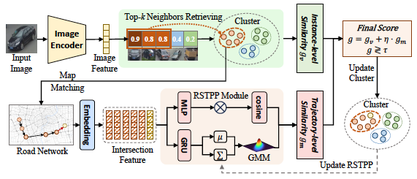
Vehicle trajectory reconstruction is crucial for understanding mobility patterns and supporting downstream applications. Existing approaches for camera-sensing data mainly cluster images by visual similarity, with limited spatio-temporal constraints, making them highly sensitive to image quality. We propose MEVAR, a mobility-enhanced framework that integrates an instance-level visual module with a road-embedded spatio-temporal point process to model the joint probability of trajectory points. This relaxes reliance on appearance features and enforces trajectory-level consistency. Furthermore, we introduce a self-supervised iterative optimization scheme that alternately refines the mobility model and clustering results without labeled data. Experiments on two large-scale highway datasets demonstrate that MEVAR achieves superior accuracy and generalization compared with strong baselines.

@inproceedings{Ma2026MEVAR,
title={MEVAR: Mobility-Enhanced Vehicle Trajectory Reconstruction from Camera Sensing Networks},
author={Ma, Jingtian and Wang, Jingyuan},
booktitle={Proceedings of the 51st IEEE International Conference on Acoustics, Speech, and Signal Processing},
year={2026}
}