Current Visitors:
Beihang Interest Group on SmartCity (BIGSCity)
The Beihang Interest Group on Smart City (BIGSCity Lab) focuses on data-driven science and technologies for building smarter and more intelligent cities. Its research interests span urban computing, spatio-temporal data mining, interpretable machine learning, and data visualization. BIGSCity has published more than 70 papers in CCF-A and UTD-24 journals and conferences across data mining and artificial intelligence, including PNAS, Management Science, Journal of Finance, TKDE, TOIS, KDD, NeurIPS, ICML, ICLR, AAAI, and IJCAI.
Technologies developed by BIGSCity have been deployed in a wide range of real-world scenarios such as urban planning, intelligent transportation, and public health services. These innovations have benefited tens of millions of residents in cities including Beijing, Tianjin, Shenzhen, Wuxi, and Chengdu.
Talent Recruitment
Our lab is recruiting highly self-motivated undergraduate interns, master’s students, and Ph.D. students in the areas of AI for Science, Agentic AI, and Embodied Intelligence Models. Interested candidates are welcome to send their CVs to: jywang@buaa.edu.cn.
实验室在AI for Science,Agentic AI,具身智能大模型方向招收具有自驱力的本科实习生,硕士研究生,以及博士研究生。感兴趣的同学请发简历至邮箱:jywang@buaa.edu.cn。
实验室招聘青年教师、博士后,有意者请联系 jywang@buaa.edu.cn。
News
BIGCity: A Universal Spatiotemporal Model for Unified Trajectory and Traffic State Analysis
BIGCity (纵横) is a unified spatiotemporal model designed to process text, trajectory, and traffic flow data simultaneously. As illustrated in the figure below, BIGCity supports eight distinct tasks across two primary categories: traffic state prediction and trajectory analysis. Specifically, traffic state prediction encompasses one-step (O-Step) and multi-step (M-Step) flow prediction, as well as traffic state imputation (TSI). The trajectory tasks include travel time estimation (TTE), next-hop prediction (NextH), similar trajectory search (Simi), trajectory classification (CLAS), and trajectory recovery (Reco). read more

BIGCity advances the field with two primary contributions:
1. Unified Spatiotemporal Data Representation: We introduce the STUnit and the ST Tokenizer. Premised on the observation that heterogeneous urban data is intrinsically anchored to the city road network—where nodes possess both static structural attributes and dynamic traffic states—the ST Tokenizer is engineered to rigorously capture this complex network topology.
1) Road Network Representation: The ST Tokenizer deploys parallel static and dynamic encoders to disentangle time-invariant properties from temporal fluctuations. Subsequently, a fusion encoder synthesizes these distinct embeddings to yield a holistic, dynamic representation of the road network.
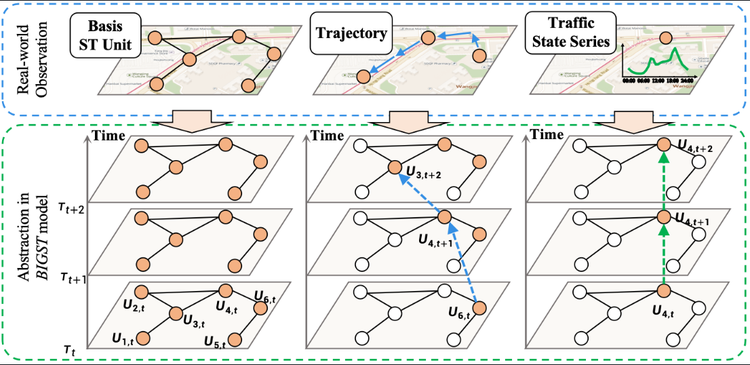
2) Representation of Spatio-Temporal Data: As illustrated in the figure below, we observe that both trajectories and traffic states are fundamentally sequences sampled from a dynamic road network. From this perspective, the primary distinction between the two lies in their sampling mechanisms. Consequently, we designed the STUnit to unify both trajectory and traffic state data into a standardized sequence format.
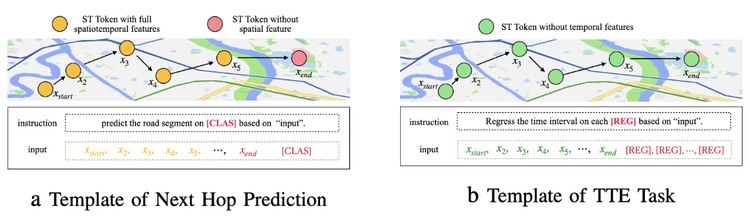
2. Task-oriented Prompts: To resolve ambiguity where identical spatiotemporal inputs correspond to different tasks, we introduce task-oriented prompts as identifiers. This unifies diverse ST tasks into a single dataset for joint training. We categorize tasks into four types (Table 1) yielding either discrete classification or continuous regression outputs, designated by [CLAS] and [REG] placeholders respectively. These placeholders, combined with task-specific templates (detailed in Section V.A), explicitly define output types and quantities for the model.
Welcome to visit our GitHub repository and website for more details.
If you find BIGCity useful for your research or development, please cite the following paper.
Xie Yu, Jingyuan Wang, Yifan Yang, Qian Huang, Ke Qu. “BIGCity: A Universal Spatiotemporal Model for Unified Trajectory and Traffic State Data Analysis”. In Proceedings of the 41th International Conference on Advances on Data Engineering (ICDE '25). 2025, pp. 4455-4469